
Estimated reading time: 5 minutes · Last updated:
As first reported by CNBC, Johnson & Johnson's Ottava surgical robot won Food and Drug Administration clearance this summer for use in 10 general surgery procedures and marks the company's major bid to challenge Intuitive Surgical in soft-tissue robotics. J&J is pitching Ottava on a smaller footprint and a table-integrated arm design it says occupies 30% to 50% less space than traditional systems. The company also plans to lean on Ethicon, its longstanding operating-room supply business, to bundle instruments and speed adoption. J&J's surgery business generated $5.16 billion in the first six months of the year, underlining why management views Ottava as a strategic MedTech growth engine.
one of the most significant MedTech innovations we will bring to market this decade.
Joaquin Duato
Key takeaways
- FDA clearance and scope: Ottava won FDA clearance this summer for 10 general surgery procedures, including gallbladder and spleen removal, gastric bypass and a specific hernia repair.
- J&J scale in surgery: J&J's surgery business generated $5.16 billion in revenue through the first six months of the year, about 30% of MedTech sales.
- Market growth forecast: Precedence Research projects the U.S. surgical-robotics market will grow from roughly $4.4 billion in 2025 to $18.75 billion by 2035 and the global market from $14.45 billion in 2026 to $50.29 billion by 2035.
- Incumbent scale: Intuitive Surgical had a global installed base of 11,710 da Vinci systems at the end of June, with 6,615 in the U.S., and performed over 3.1 million procedures in 2025.
Table of contents
- Key takeaways
- How Ottava’s design is meant to change operating-room logistics
- Commercial strategy: Ethicon, bundling and a measured rollout
- The incumbent advantage and the market J&J hopes to grow
- Early skepticism and the operational hurdles J&J must address
- Balanced outlook: growth drivers and headwinds
- What to be careful about
- Frequently asked questions
How Ottava’s design is meant to change operating-room logistics
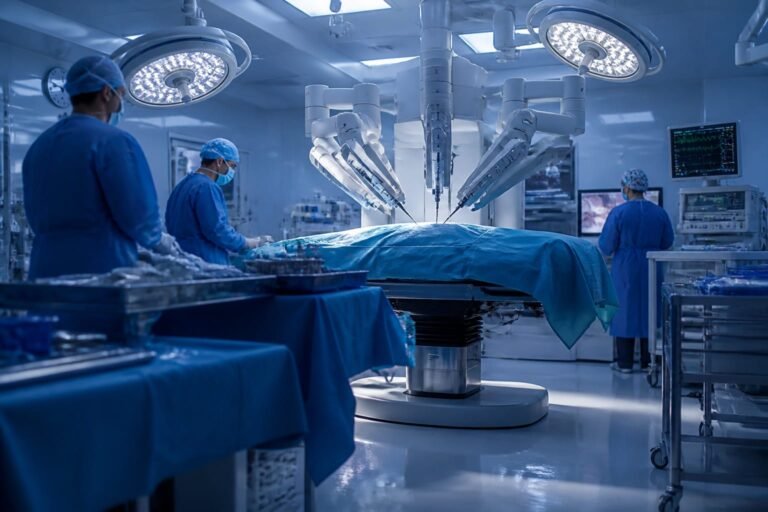
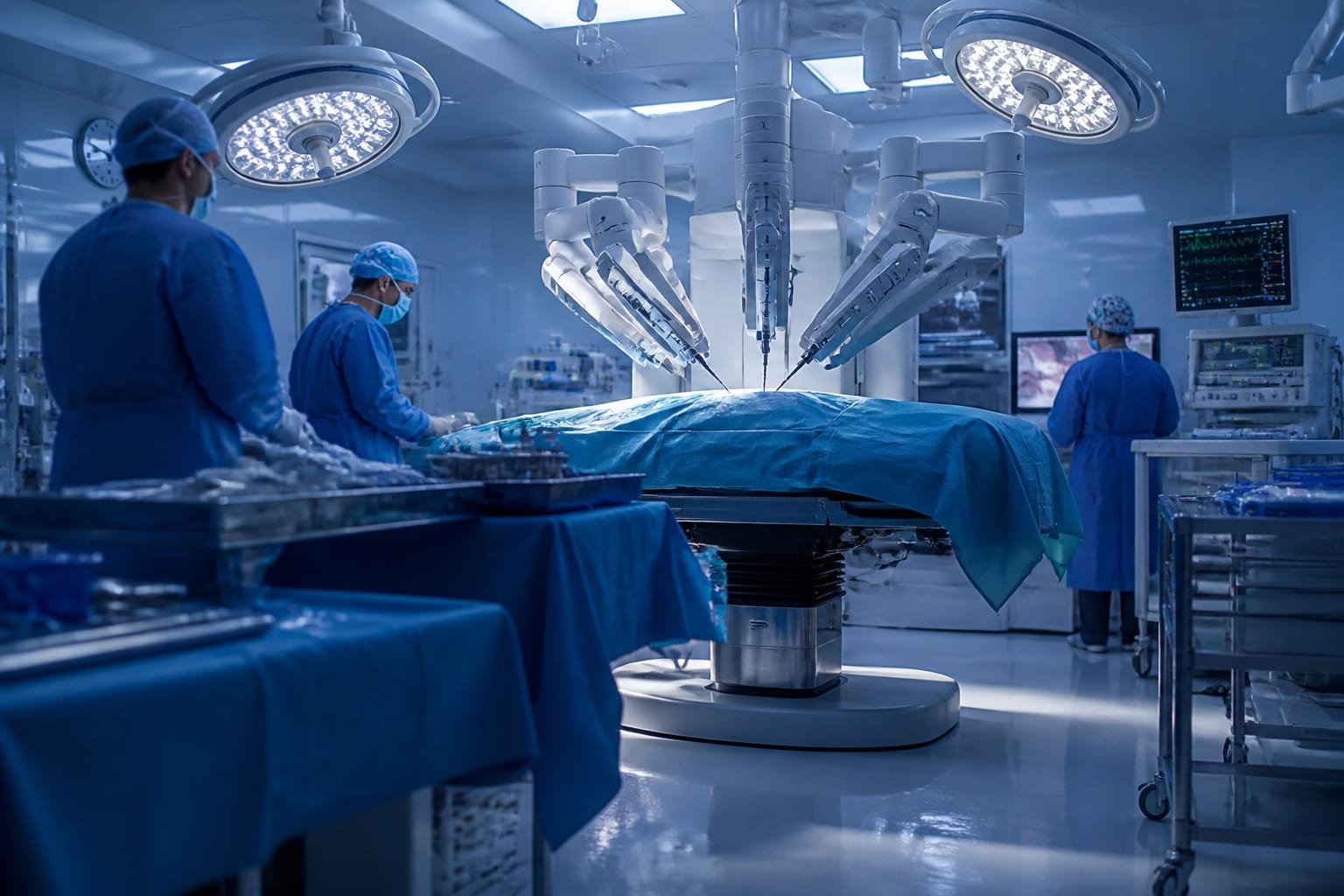
J&J is pitching Ottava as a systems-level change in how hospitals run robotic programs. The standout technical feature is robotic arms that fold into the operating table; with a button the arms position themselves for a planned procedure. That table-integrated approach, J&J says, lets Ottava occupy 30% to 50% less space than traditional robots and reduces the need to renovate or expand rooms.
Executives argue the smaller footprint shortens setup time and eases scheduling pressure in surgical suites. Hani Abouhalka, head of J&J’s surgery and robotics unit, told CNBC, “We’re currently the global leader in surgery,” and framed Ottava as central to J&J’s aim to become “a leader in surgical robotics.” The design differences are explicit counterpoints to Intuitive’s cart- or boom-mounted da Vinci units and Medtronic’s multi-cart Hugo system.
Commercial strategy: Ethicon, bundling and a measured rollout
J&J plans to sell Ottava into operating rooms where Ethicon already supplies sutures, staplers and energy devices. That installed commercial presence is the company’s chief leverage: Dr. Jacob Greenberg, an associate professor of surgery at Duke University and paid consultant to J&J, said systems that already use Ethicon tools could see bundled discounts if they add Ottava.
Management is tempering ramp expectations. Tim Schmid, global head of MedTech, described a “very disciplined approach to commercialization” that starts with a select group of hospitals and expands instruments, indications and geographies over time. J&J has not disclosed an asking price for Ottava and says it is considering different pricing models — a notable omission given Intuitive reported an average selling price of $1.59 million for purchased da Vinci systems in the second quarter.
The incumbent advantage and the market J&J hopes to grow
Intuitive Surgical is the incumbent and holds a wide lead in scale and recurring revenue. The da Vinci platform has treated more than 20 million patients since inception, and Intuitive reported over 3.1 million procedures in 2025. At the end of June the company had 11,710 installed systems globally, 6,615 of them in the U.S.
That installed base feeds spare-part and instrument sales — Intuitive models instruments and accessories to be roughly 60% of about $11.76 billion in projected revenue this year, with system sales about 25% and services the remainder. J&J’s play is partly to expand total robotic use: UCSF Health estimates less than a quarter of U.S. surgeries are performed robotically today, so J&J argues multiple suppliers can win as the market grows.
Early skepticism and the operational hurdles J&J must address
Not all observers see Ottava as an immediate threat to Intuitive. Oppenheimer analysts wrote that U.S. competition is currently a “non-factor,” citing sterilization difficulties and limited production capacity for Ottava in 2026 and 2027. Those constraints speak to two concrete risks: a hospital’s willingness to train staff around a new workflow, and J&J’s ability to manufacture at scale.
Surgeons and analysts who favour Ottava point to workflow and reliability. UT Health Houston physician Erik Wilson, lead investigator for the Ottava study and a paid J&J consultant, called it “a nice workflow” and said, “At the end of the day, it just needs to work well.” J&J will need to resolve any sterilization and capacity issues quickly if it hopes to convert interest into sustained placements.
| Company | Product | FDA status / timing | Scale or company figure cited |
|---|---|---|---|
| Intuitive Surgical | da Vinci | Cleared for surgical assistance since 1997; da Vinci 5 cleared in 2024 | 11,710 installed systems at end of June; over 3.1 million procedures in 2025 |
| Johnson & Johnson | Ottava | FDA clearance this summer for 10 general surgery procedures | J&J surgery revenue: $5.16 billion through first six months of the year |
| Medtronic | Hugo | FDA cleared December 2025 (initial urology clearance); launched earlier in Europe | Company expects 250 Hugo units installed by year-end and >50,000 procedures by year-end (company disclosure) |
Balanced outlook: growth drivers and headwinds
The case for
- Smaller footprint and table-integrated arms could make Ottava attractive to hospitals lacking space for large carts, lowering the practical barrier to entry.
- Ethicon’s operating-room footprint gives J&J a commercial channel to bundle instruments with Ottava, which could accelerate system placements and recurring instrument revenue.
- Market expansion, not just share-shift: Precedence Research projects large market growth to 2035, which could allow multiple suppliers to grow simultaneously.
The case against
- Operational issues such as sterilization workflow and limited 2026–2027 production capacity could delay placements and slow revenue recognition.
- Intuitive’s installed base, service network and recurring revenue from instruments create inertia that is costly and slow to overcome.
- J&J has not disclosed pricing or detailed sales milestones, leaving investors unable to model near-term financial impact precisely.
What to be careful about
- Sterilization and workflow challenges cited by Oppenheimer analysts that could reduce surgeons’ enthusiasm for Ottava.
- Limited production capacity reported for 2026 and 2027 that could constrain placements even where demand exists.
- Long hospital capital cycles for purchasing surgical robots, which stretch adoption over years rather than quarters.
- Lack of disclosed pricing and utilization metrics from J&J, which increases uncertainty about the system’s near-term revenue contribution.
The bottom line
Ottava is J&J’s highest-profile push into general surgical robotics and combines a distinctive table-integrated arm design with a commercial channel in Ethicon. The product’s smaller footprint and workflow features give it a credible adoption angle, but short-term obstacles—sterilization workflow questions, constrained production capacity and no disclosed pricing—create real uncertainty. For investors and hospital leaders the near-term story will be metrics: placements, utilization per robot, instrument attach rates and any new approvals. Those datapoints will determine whether Ottava is a competitor that grows the market, a niche challenger, or somewhere in between.
What to watch
- Watch for expanded FDA approvals or cleared indications for Ottava; no date has been set for additional approvals.
- Watch for progress on J&J’s orthopedics divestiture expected in 18 to 24 months after the October 2025 announcement, which places completion in 2027.
- Watch market-share updates toward 2030, when some analysts project J&J could hold about 15% of the U.S. robotic-surgery market and Intuitive about 75%.
Frequently asked questions
What procedures is Ottava currently cleared to perform?
Ottava is cleared for 10 general surgery procedures, including gallbladder and spleen removal, gastric bypass, a specific hernia repair and an operation to treat severe acid reflux, according to J&J.
Who are Ottava’s main competitors and how big are they?
Intuitive Surgical is the incumbent: its da Vinci platform had 11,710 installed systems at the end of June and performed over 3.1 million procedures in 2025. Medtronic’s Hugo was FDA cleared in December 2025 and the company expects 250 Hugo installs by year-end and more than 50,000 completed procedures by year-end.
When might Ottava move the needle on J&J’s results?
J&J executives say they expect Ottava to be a material financial contributor 'by the end of the decade,' and some analysts model nontrivial market share by 2030; the company has not provided unit-placement or revenue guidance yet.
Related reading
This article is information, not financial advice. Anyone acting on it should do their own checks.