
Estimated reading time: 6 minutes · Last updated:
GE Appliances has put more than 800 AI agents into its factories, warehouses and supply chain, the company said, tying those agents to a data platform it calls Brilliant Factory. Using Google Cloud’s Gemini Enterprise, the system lets frontline staff query shift-level production, parts and worker-activity data in minutes rather than waiting for a data scientist. The rollout already shows measurable effects: a supplier-facing agent built in 2025 automated routine order-status queries across more than 600 suppliers and reduced back orders by 25%, GE Appliances says, while other tools scan customer feedback and images to detect defects earlier.
“AI is now integral to the way work gets done at GE Appliances,” said Mandar Deo.
Mandar Deo, chief digital officer, GE Appliances
Key takeaways
- GE Appliances says it has deployed more than 800 AI agents across manufacturing, logistics and supply chain, running on a platform the company calls Brilliant Factory.
- One AI agent built in 2025 automated communication with more than 600 suppliers and cut back orders 25%, the company said.
- GE Appliances has invested more than $3.5 billion in U.S. manufacturing since 2016, and the company says those investments make small efficiency gains add up.
- The Roper Corporation plant in LaFayette, Georgia completed a $180 million expansion, added more than 600 jobs and more than tripled its use of robots, the company said.
Table of contents
- Key takeaways
- How GE built a network of more than 800 agents
- Supplier automation that cut back orders 25%
- What the LaFayette expansion bought: jobs, flexibility and robots
- Agents now feed decisions about production, staffing and inventory
- How the rollout could play out
- What to be careful about
- Frequently asked questions
How GE built a network of more than 800 agents
GE Appliances says it has connected artificial intelligence agents to production lines, warehouses and supply-chain systems and runs them inside a data platform the company calls Brilliant Factory. The implementation draws on Google Cloud’s Gemini Enterprise as the foundation for agentic workflows and natural-language queries, a configuration GE Appliances identified in its announcement. Mandar Deo, the company’s chief digital officer, framed the effort as a change in how work gets done: employees can now ask the system for answers that previously required a data scientist to pull and prepare.
That change is practical rather than experimental. GE Appliances highlights faster access to shift-level metrics — staff can review a full shift’s data in minutes instead of hours — and the platform stitches together production, parts and worker-activity feeds so agents can act on combined signals. The company describes the build as a deliberate scale exercise: dozens of agents handling discrete tasks rather than a single, general-purpose model.
Supplier automation that cut back orders 25%
A visible early win for GE Appliances came in 2025, when the company deployed an agent to manage routine supplier communications. GE Appliances says that single agent automated order-status queries with more than 600 suppliers and cut back orders by 25%, freeing parts and procurement staff to focus on higher-value work. The parts organisation ships roughly 27 million parts a year to more than 700 suppliers, the company adds, a scale that amplifies even modest efficiency gains.
The supplier agent is a narrow, transactional application: it handles routine status checks and exceptions escalation rather than replacing procurement judgement. GE Appliances also points to a separate tool that scans customer feedback and photos to surface defects earlier, which feeds quality-control workflows and the same data fabric the supplier agent uses. Together, these targeted agents show how automation can convert repeated manual tasks into capacity for problem-solving at scale.
What the LaFayette expansion bought: jobs, flexibility and robots
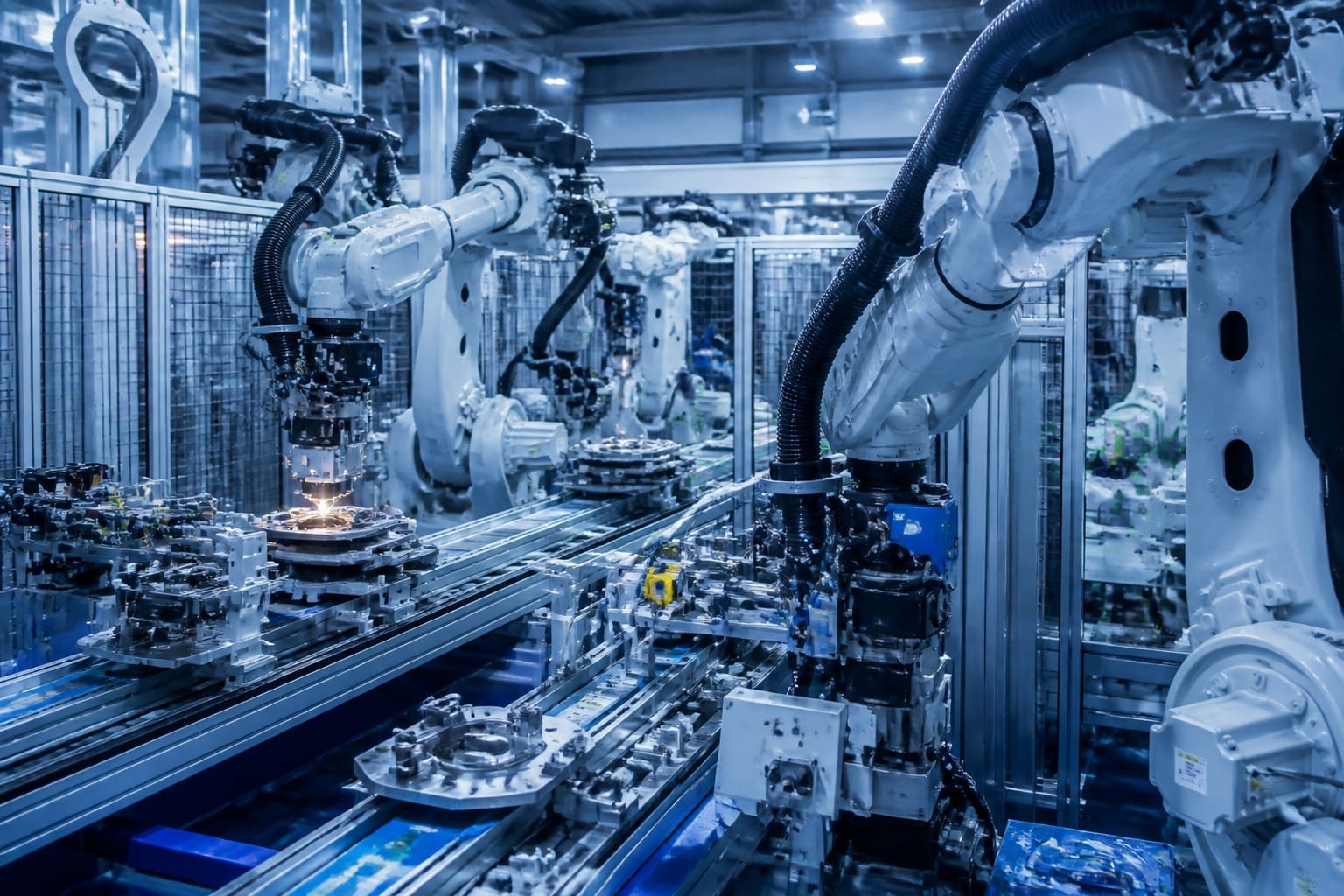
The Roper Corporation plant in LaFayette, Georgia illustrates the hardware side of GE Appliances’ strategy. The company completed a $180 million expansion at that facility — $60 million more than originally planned, GE Appliances said — and reports the project added more than 600 jobs while more than tripling how much the plant uses robots. The upgraded lines can build gas, electric or induction ranges on the same line, giving the plant the flexibility to respond as demand shifts.
Luther Ingram, the plant manager, framed the investment as a combination of automation and local workforce skills that produces higher-value work and faster product rollouts, a point GE Appliances repeats in its releases. New robots assemble glass cooktops and rotate units for final assembly; paired with the AI agents that surface demand and quality signals, the mechanical upgrades aim to reduce downtime and shorten the time between a shift in demand and a production response.
Agents now feed decisions about production, staffing and inventory
GE Appliances describes the agents not only as defect detectors but as inputs to operational decisions. The same signals that flag a quality issue are routed into models and dashboards that influence how much to produce, how to staff a shift and how much inventory to hold on hand. That shift replaces a prior pattern in which plant managers relied on judgment plus stacks of reports; agents surface real-time demand and quality changes and make them actionable at line speed.
The mechanics matter: a line that can switch among product types only delivers value when the plant knows, in real time, which configuration demand is moving toward. By linking production telemetry, parts flow data and customer feedback, GE Appliances says its agents shorten the feedback loop and reduce the friction of switching runs, which in aggregate is the company’s stated rationale for deploying agents at scale.
| Item | Scope | Key figures | Source |
|---|---|---|---|
| AI agents | Manufacturing, logistics, supply chain | More than 800 agents | GE Appliances announcement |
| Supplier agent | Supplier communications | More than 600 suppliers; 25% cut in back orders | GE Appliances announcement |
| LaFayette plant expansion | Roper Corporation plant in LaFayette, Georgia | $180 million; 600+ jobs; >3x robot use | GE Appliances announcement |
| Parts shipments | Parts team operations | Roughly 27 million parts a year; 700+ suppliers | GE Appliances announcement |
How the rollout could play out
The case for
- Faster exception handling and automated supplier replies can shrink back orders and improve parts availability, reinforcing uptime and customer service.
- Real-time production signals tied to flexible lines could reduce changeover downtime and let plants shift capacity toward higher-margin configurations quickly.
- Scaled automation of routine tasks may free technical staff for continuous improvement projects, increasing throughput without proportional headcount growth.
The case against
- Dependence on a single cloud platform and on integrated data feeds raises concentration risk if the vendor contract or integrations change.
- If agents mishandle exceptions or misclassify supplier responses, human teams may still need to rework cases, creating new operational friction.
- Scaling across plants requires consistent data quality and governance; gaps there could limit the agents’ accuracy and the expected payoff.
What to be careful about
- Concentration on Google Cloud’s Gemini Enterprise creates a vendor and integration dependency not detailed in the announcements.
- The supplier-facing agent automates routine queries but could generate errors on nonstandard orders or contract exceptions, producing work reflows.
- Robotics growth at the LaFayette plant increases maintenance and skills requirements that GE Appliances has not quantified in the announcement.
- Reported efficiency gains are given in relative terms (25% back-order cut) without a public dollar or baseline definition, which obscures total savings.
The bottom line
GE Appliances’ announcement makes a clear case for scale: targeted agents that automate repeated tasks can multiply small gains across millions of parts and dozens of production lines. The company links those software gains to parallel capital spending — $180 million at LaFayette and more than $3.5 billion invested in U.S. manufacturing since 2016 — to argue that the combined hardware and software upgrades deliver measurable operational improvements. The most important next steps for verification are dollarised savings, a live deployment timetable for the 800+ agents and independent evidence that defect detection and changeover times have fallen as claimed.
What to watch
- Watch for any published rollout schedule from GE Appliances that lists where and when additional agents will go live; no date has been set.
- Watch for a Google Cloud or GE Appliances case study that quantifies operational savings in dollars or hours; no date has been set.
- Watch for further production or expansion notices from the LaFayette plant that update robot counts or job totals; no date has been set.
Frequently asked questions
How many AI agents has GE Appliances deployed?
GE Appliances says it has deployed more than 800 AI agents across manufacturing, logistics and supply chain, operating on a platform the company calls Brilliant Factory and using Google Cloud’s Gemini Enterprise.
How did the supplier agent reduce back orders?
According to GE Appliances, an agent built in 2025 automated routine order-status communications with more than 600 suppliers and reduced back orders by 25%, freeing parts staff to focus on higher-value tasks.
What did the Georgia expansion include?
The Roper Corporation plant in LaFayette, Georgia completed a $180 million expansion — $60 million over plan — that the company says added more than 600 jobs and more than tripled the plant’s use of robots.
Related reading