Estimated reading time: 8 minutes · Last updated:
Recruitment is where Singapore employers rely on AI in HR more than anywhere else, a survey of 1,000 employers by the Singapore National Employers Federation (SNEF) shows. Among firms using the technology in HR, 49 per cent apply it to recruitment and selection, typically sifting and shortlisting applicants. People still stay in charge. Some 85 per cent of AI-supported HR use cases involve human input. SNEF released the results at its Employers' Summit 2026 on 30 October 2026, alongside a subsidised programme that pairs firms with consultants. Polling ran from June to July and covered small and medium-sized enterprises, defined as having 200 or fewer staff, as well as larger companies.
SNEF does not claim to have every answer on AI. I don't think anybody does.
Kuah Boon Wee, SNEF president
Key takeaways
- Recruitment leads: Among Singapore employers using AI in HR, 49 per cent apply it to recruitment and selection, ahead of performance, learning and mobility at 45 per cent and workforce planning at 39 per cent, SNEF's survey of 1,000 employers shows.
- Humans stay involved: Across nearly 3,000 AI use cases counted by SNEF, 85 per cent required a person's input, while 15 per cent let AI act without prior sign-off, mostly in routine administration.
- Size gap: Large enterprises lead adoption at 81 per cent against 65 per cent for SMEs, with big firms favouring Workday and SAP SuccessFactors and smaller ones turning to ChatGPT and Microsoft Copilot.
- Skill erosion worry: Losing HR expertise through over-reliance on AI is the concern cited by 39 per cent of AI-using employers, and 42 per cent want clearer guidance on their legal obligations.
- Funding on offer: SNEF's new AI-HR programme, run under the Job Redesign+ grant, covers qualifying costs at up to 70 per cent for SMEs and 50 per cent for larger firms, capped at S$150,000 per project.
Table of contents
- Key takeaways
- Why Large Firms Adopt AI in HR Faster Than SMEs
- Recruitment Tops the List of HR Tasks Handed to AI
- How Often Does AI Make HR Decisions Without a Human?
- Employers Fear Skill Erosion and Want Clearer Rules
- What SNEF's AI-HR Package Offers Employers
- What could help or hinder responsible AI in Singapore HR
- What to be careful about
- Frequently asked questions
Why Large Firms Adopt AI in HR Faster Than SMEs
Company size shapes adoption. SNEF found that 81 per cent of large enterprises, meaning those with more than 200 employees, apply AI to at least one HR task. Among SMEs the share is 65 per cent, a gap of about 16 percentage points.
The tools differ as much as the rates. Bigger employers tend to buy dedicated HR platforms with AI built in, such as Workday and SAP SuccessFactors. Smaller firms more often reach for general-purpose assistants like ChatGPT and Microsoft Copilot.
That split matters for oversight. A dedicated HR platform is designed around personnel processes. A general chatbot is not, which leaves more of the structure to whoever is typing the prompt. The results released at the summit did not separate the human-oversight figures by company size, so it remains open whether SMEs using generic tools keep people in the loop as consistently as larger firms do.
Recruitment Tops the List of HR Tasks Handed to AI
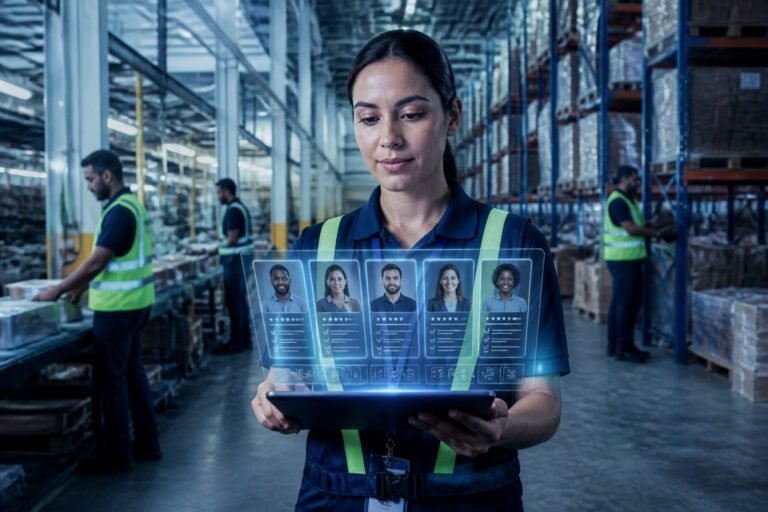
SNEF's results show AI clustering at the front end of the employee lifecycle. Recruitment and selection lead, at 49 per cent of employers using AI in HR, covering work such as sifting and shortlisting applicants. This is where applicants feel the effect first, since screening decides who reaches an interviewer at all.
Performance, learning and mobility comes next at 45 per cent. That spans managing how staff perform and guiding decisions on internal moves. Workforce planning follows at 39 per cent, including forecasts of future staffing needs and spotting where skills fall short.
More sensitive work sees far less use. Only 15 per cent of employers apply AI to higher-impact analysis, such as probing why employee relations problems arise or why people quit. The pattern points to firms that are comfortable automating volume tasks with clear inputs, and more cautious where the questions turn on judgement about individuals and workplace culture.
How Often Does AI Make HR Decisions Without a Human?
Employers reported nearly 3,000 separate instances of AI use in HR. In 15 per cent of them, roughly 450 cases, the system acted without anyone signing off beforehand.
Most of those were administrative. Some 73 per cent involved routine or high-volume processes, like resume screening and skills tests, where speed is the main gain. And 97 per cent of employers running AI without prior review had named a person empowered to step in and amend or undo the outcome.
The other 85 per cent of use cases kept people involved at three levels. In 14 per cent, AI only supplied information. In 36 per cent it put forward options for a person to pick from. In 35 per cent it reached a decision that a human then had to approve, reject or override.
Read together, those tiers show something the headline figure hides. Counting the cases where AI decided with approval and those where it decided alone, the machine made the initial call in about half of all reported uses, with people acting as reviewers rather than originators.
Employers Fear Skill Erosion and Want Clearer Rules
Among firms using AI, SNEF found the leading concern is that relying on it too heavily could hollow out HR expertise, cited by 39 per cent. Uncertainty about when to trust the machine over professional judgement follows at 36 per cent, then accountability for AI mistakes at 35 per cent. Mental fatigue from handling AI output trailed the list at 20 per cent.
Demand for help splits evenly. Some 42 per cent want clearer guidance on what they owe legally and where liability falls, and the same share want training on responsible use. On paper, legal awareness is strong: 84 per cent say they know at least one applicable legal or governance framework well, the Workplace Fairness Act among them.
Hao Shuo, SNEF's outgoing chief executive, addressed fears that AI screening could penalise jobseekers, older workers in particular, who may be less at ease with the technology. He said applicants should use AI to sharpen their resumes, while employers must check that screening tools do not build in bias. Employers know they carry liability, especially with the Workplace Fairness Act approaching, Hao said, and HR staff will remain the "ultimate decision maker" in hiring.
What SNEF's AI-HR Package Offers Employers
SNEF paired the findings with an AI-HR pre-scoped solution that bundles four strands: advice on human capital, AI tools for HR processes, consultancy on workforce transformation, and analytics on workforce skills. Practical examples include chatbots that answer routine employee questions and tools that map skills gaps and support succession planning.
Funding runs through the Workforce Development Grant (Job Redesign+). SNEF assesses each employer's needs and matches it with a specialist consultant. Qualifying costs are covered at up to 70 per cent for SMEs and 50 per cent for non-SMEs, with a ceiling of S$150,000 per project. The five appointed consultants are BDO, Elitez, EON, PwC and Skybots.
Hao said success should not be judged by how much HR work AI absorbs. The real test, in his view, is whether HR professionals become strategic partners to business leaders, with a seat in the boardroom. SNEF president Kuah Boon Wee framed the federation's role modestly, saying it could offer advisory services and connect employers with suitable partners.
| HR area | Share of AI-using employers | Example tasks |
|---|---|---|
| Recruitment and selection | 49% | Screening and shortlisting applicants |
| Performance, learning and mobility | 45% | Managing performance, internal moves |
| Workforce planning | 39% | Forecasting staffing needs, skills gaps |
| Higher-impact analysis | 15% | Causes of employee relations issues and resignations |
What could help or hinder responsible AI in Singapore HR
The case for
- Job Redesign+ funding covers qualifying costs at up to 70 per cent for SMEs, lowering the barrier for smaller firms.
- 97 per cent of employers using AI without prior review have named someone who can reverse its decisions.
- 84 per cent of AI-using employers report strong familiarity with at least one relevant legal or governance framework.
- Five consultants, BDO, Elitez, EON, PwC and Skybots, are already appointed to deliver SNEF's programme.
The case against
- AI made the initial call in about half of nearly 3,000 reported uses, leaving people largely as reviewers.
- 42 per cent of employers remain unclear on their obligations and liabilities when using AI in HR.
- SMEs lean on general-purpose tools such as ChatGPT and Microsoft Copilot rather than dedicated HR platforms.
- 39 per cent fear over-reliance will erode the HR expertise needed to judge AI output.
What to be careful about
- AI resume screening, used in most of the cases where AI acts without prior sign-off, could disadvantage older jobseekers, and Hao said employers remain liable under the incoming Workplace Fairness Act.
- Where AI decides and a person merely approves, as in 35 per cent of use cases, review can become a formality if staff lack time or confidence to override.
- Employers unsure of their obligations, 42 per cent of AI users, may deploy screening tools before they understand where liability falls.
The bottom line
SNEF's figures describe adoption that is broad but bounded. Some 65 per cent of SMEs and 81 per cent of large firms already use AI somewhere in HR, and recruitment is where it lands first. Employers say they want people in control, and the oversight numbers largely back that up. Yet AI already makes the first call in about half of reported uses, which shifts the human role from deciding to checking. The Workplace Fairness Act, which Hao described as approaching, will test whether that checking holds up for screening tools. SNEF's subsidised programme offers firms help with the transition, and Poon Hong Yuen will oversee it from 1 December 2026.
What to watch
- Poon Hong Yuen, former deputy secretary at the Ministry of Digital Development and Information, joins SNEF as CEO-designate on 1 November 2026.
- Poon formally takes over from Hao Shuo as SNEF chief executive on 1 December 2026, inheriting the newly launched AI-HR programme.
- Watch for the Workplace Fairness Act to take effect, which Hao said keeps employers alert to liability for biased screening; no commencement date was given.
Frequently asked questions
How many Singapore employers use AI in HR?
SNEF's poll of 1,000 employers, run between June and July 2026, found 81 per cent of large enterprises and 65 per cent of SMEs use AI in at least one HR function. SMEs were defined as firms with 200 or fewer employees.
Can AI reject job applicants without a human in Singapore?
In SNEF's count, 15 per cent of nearly 3,000 AI use cases involved no prior human sign-off, and 73 per cent of those were routine tasks such as resume screening. Nearly all of those employers, 97 per cent, had someone able to reverse the decision, and Hao Shuo said HR professionals remain the final decision makers in hiring.
What should older jobseekers do about AI resume screening?
Hao Shuo, SNEF's outgoing chief executive, said jobseekers should learn to use AI to improve their resumes so they can "stand out among the crowd". He said employers, for their part, must ensure screening tools do not introduce bias.
Who will lead SNEF after Hao Shuo?
Poon Hong Yuen, formerly deputy secretary at the Ministry of Digital Development and Information, joins as CEO-designate on 1 November 2026. He formally succeeds Hao on 1 December 2026.
Related reading