
Estimated reading time: 5 minutes · Last updated:
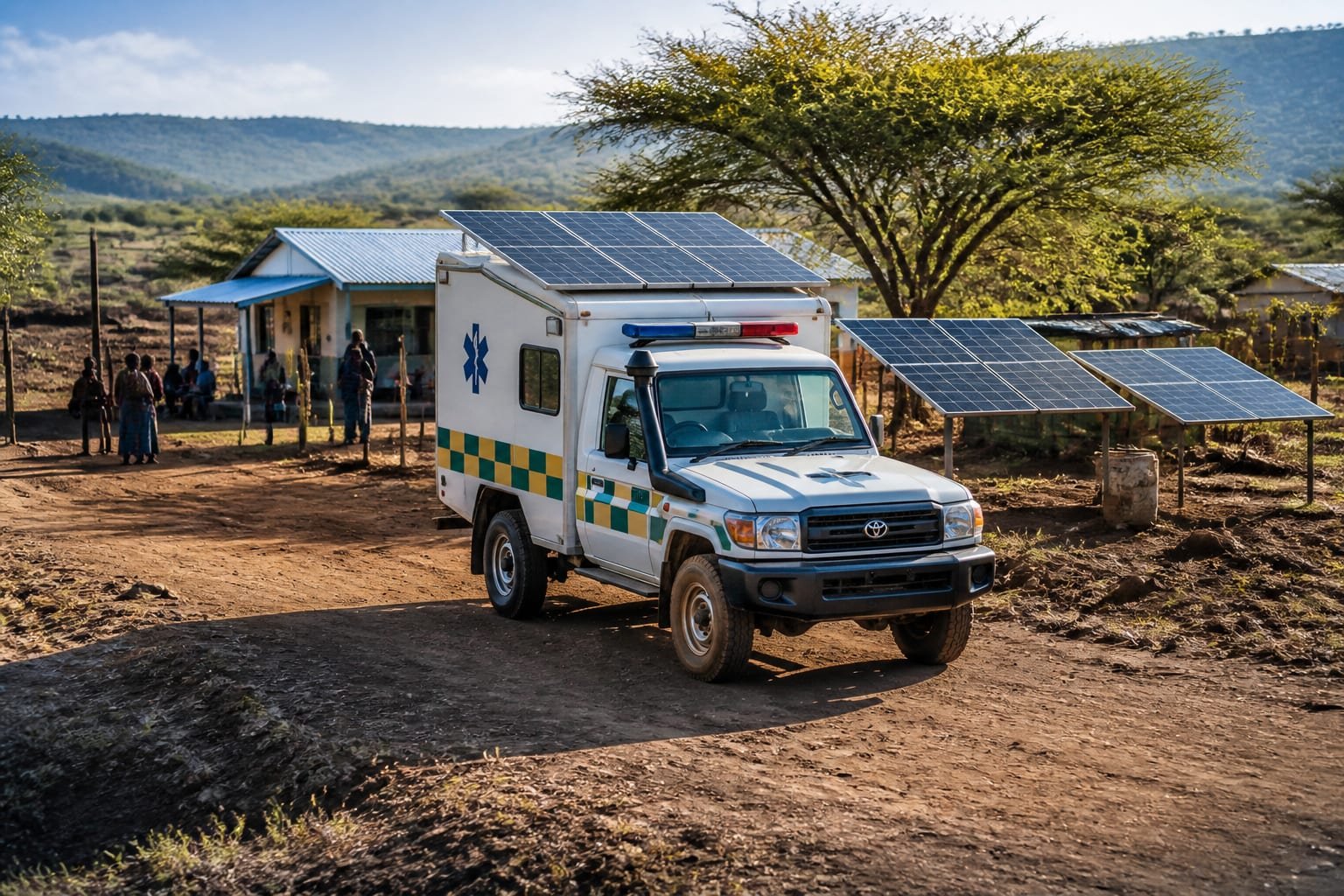
Stella Juva is a road‑legal ambulance fitted with integrated solar panels and a 50 kWh battery that can power medical devices while parked and drive between remote sites. Solar Team Eindhoven at Eindhoven University of Technology built the vehicle and tested it in Narok county, Kenya, covering more than 800 km across field locations during practical trials. The vehicle carried diagnostics such as an X‑ray, ultrasound and an AED and, in a two‑day run, could have provided care to approximately 200 people. These findings were published as first reported by Euronews and are grounded in on‑site testing with partner Amref Health Africa.
This means that healthcare workers can keep using medical equipment at all times.
Yarno Basten, Solar Team Eindhoven
Key takeaways
- Design and maker: Solar Team Eindhoven at Eindhoven University of Technology developed Stella Juva, a road‑legal electric ambulance fitted with integrated solar panels.
- Energy system: Stella Juva stores solar energy in a 50 kWh battery and can power onboard medical equipment while stationary.
- Field performance: During tests in Kenya the ambulance covered more than 800 km and operated in remote locations including Mosiro and Narok.
- Care capacity: In a two‑day trial the team estimated the vehicle could have provided care to approximately 200 people and offered up to 40 ultrasound scans for pregnant women per outreach.
Table of contents
- Key takeaways
- How Stella Juva generates and stores power
- What the Kenya trials showed about resilience in the field
- Medical kit and immediate impact on diagnostics
- Scaling prospects and operational limitations
- How Stella Juva could succeed or stall
- What to be careful about
- Frequently asked questions
How Stella Juva generates and stores power
Stella Juva is an electric vehicle whose bodywork integrates photovoltaic panels. Those panels charge a 50 kWh battery that supplies the drivetrain and the ambulance’s medical systems. The team designed extensions that deploy when the vehicle is parked; the deployed panels add generation capacity and double as shade for treatment areas. The designers report that, while stationary in field conditions, the vehicle produced more energy than the medical kit consumed during simultaneous use, letting clinicians run diagnostic devices without external grid power.
That combination — onboard generation plus a dedicated battery pack — is what the builders describe as an energy independent approach to outreach care. By storing solar harvest in a 50 kWh pack, the ambulance can continue to operate after sundown and while driving between villages, reducing reliance on fuel or unreliable local electricity.
What the Kenya trials showed about resilience in the field
Solar Team Eindhoven ran practical tests in collaboration with Amref Health Africa, sending Stella Juva on routes around Narok county and to remote sites such as Mosiro. Over the course of those deployments the vehicle covered more than 800 km on a mix of paved and challenging off‑road terrain. On one mission the team spent six hours driving to reach a distant field location, which tested the vehicle’s endurance and suspension.
Mechanical issues arose: a component the team calls the toelink — the connection between the front wheels and the steering mechanism — failed during off‑roading. The designers had planned for that failure mode and replaced the part in about half an hour, allowing the vehicle to complete the trial. The incident underlined both the importance of modular, serviceable parts and the additional maintenance burden that rough roads create for prototype vehicles.
Medical kit and immediate impact on diagnostics
Stella Juva carries equipment intended for outreach clinics: an X‑ray unit, ultrasound, an Automated External Defibrillator and refrigerated storage for vaccines. During the two‑day exercise the team calculated that the ambulance could have provided treatment to approximately 200 people while parked with panels extended. The project specifically highlights the potential to deliver up to 40 ultrasound scans for pregnant women during a single outreach, a capability that Amref Health Africa says could help identify pregnancy risks earlier in communities with high maternal and child mortality.
Bringing diagnostics to communities — rather than moving patients long distances — is the operational model here. The combination of imaging, defibrillation and cold storage permits triage, immediate stabilisation and point‑of‑care decisions, which the partners argue may shorten time to intervention in locations with patchy infrastructure.
Scaling prospects and operational limitations
The research team hopes Stella Juva’s results will attract companies, social organisations and governments interested in scaled deployments. The builders say they are open to partners who want to explore rolling the vehicle out more widely, but they do not yet present a production timeline or costs in the published account. Scaling will require commitments for manufacturing, maintenance networks and funding to buy and operate units where they are needed.
Operational constraints are already visible: rough roads can damage steering linkages and other mechanical parts, requiring field‑serviceable design choices and local spare parts. Solar generation depends on local insolation and the panel area fitted to the vehicle; while the trial showed surplus generation when parked, real‑world variability in weather and seasonal sunlight will affect sustained independence and must be factored into logistics and battery sizing.
How Stella Juva could succeed or stall
The case for
- On the positive side, integrated panels plus a 50 kWh battery proved sufficient in tests to run diagnostics while stationary, supporting independent outreach operations.
- Field validation with Amref Health Africa demonstrates a clear use case in areas such as Narok where transport and grid power are unreliable, strengthening the project’s case to health NGOs and funders.
The case against
- Scaling could be limited by manufacturing cost, the need for service parts and the logistics of maintaining vehicles in remote regions.
- Real‑world factors — seasonal sunlight variability, heavier loads, and prolonged off‑road use — may reduce on‑site surplus generation and demand larger batteries or backup systems.
What to be careful about
- Mechanical fragility on rough terrain: the toelink failure in Kenya required on‑site replacement and highlights the need for modular spares and trained technicians.
- Energy limits: a 50 kWh battery constrains driving range and buffered operating time; extended outreach in low‑sun periods will need additional storage or charging options.
- Dependence on external partners and funding: the team says it is open to organisations to scale, implying deployments require commitments from manufacturers, donors or governments.
The bottom line
Stella Juva demonstrates a working combination of photovoltaic generation, a 50 kWh battery and clinical equipment that can deliver diagnostics and basic treatment off‑grid. Trials with Amref Health Africa in Narok showed the concept works in rough conditions but also exposed mechanical and logistical limits that must be solved for wider use. Moving from prototype to fleet will hinge on partners willing to fund manufacturing, establish spare‑parts supply chains and validate performance across seasons and terrains. The project’s field data make a concrete case, but the next step is practical investment and scaled demonstrations.
What to watch
- Look for announcements of pilot deployments with Amref Health Africa; no date has been set.
- Watch for commercial partners or manufacturers to step forward with plans to produce more Stella Juva units; no date has been set.
- Look for further field trials that test seasonal performance and maintenance cycles; no date has been set.
Frequently asked questions
What powers Stella Juva and how much energy does it store?
Stella Juva uses integrated solar panels to charge an onboard battery; the team reports a 50 kWh battery pack that stores generated energy for driving and running medical equipment.
How extensively was the ambulance tested in the field?
In collaboration with Amref Health Africa the vehicle drove more than 800 km around Narok county and reached remote sites such as Mosiro, including a six‑hour drive to one location during trials.
How many patients could a single outreach serve?
The team says that during a two‑day trial Stella Juva could have provided care to approximately 200 people and could offer up to 40 ultrasound scans for pregnant women on one outreach.
Related reading